Dot · one unit
A short signal lasting one timing unit.
International Morse · Free reference sheet
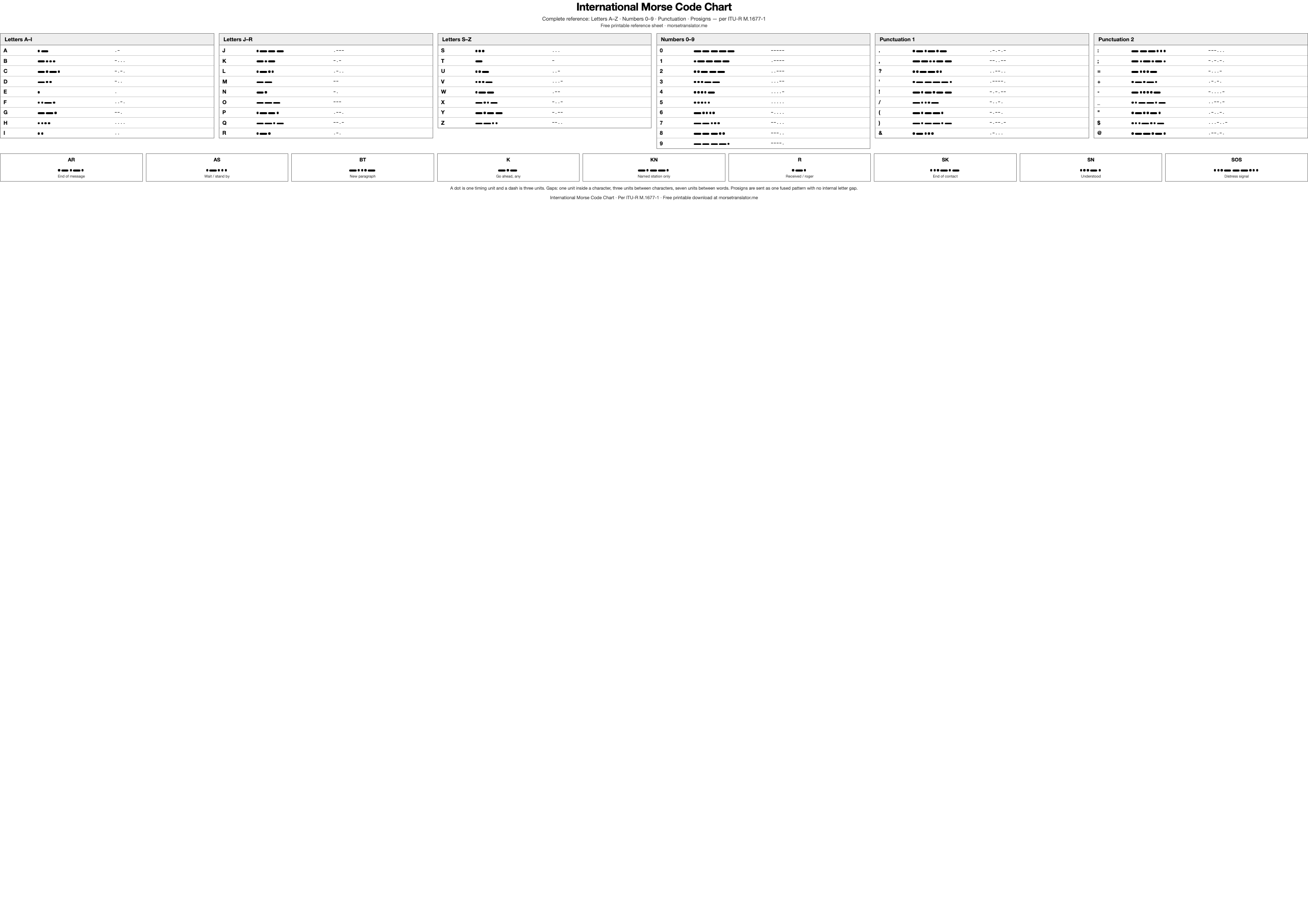
A complete International Morse code chart covering letters A-Z, numbers 0-9, punctuation, and prosigns. Download the print-ready PDF or high-resolution PNG, or print this page directly.
Both files are hosted on this site and stay available offline after download. Nothing is uploaded.
Tables per ITU-R M.1677-1
Read each row from the character to its dot-and-dash pattern and plain-text code. The signal pattern column shows the same information as the code column at a glance, so the table is fully readable without JavaScript.
| Character | Signal pattern | Morse code |
|---|---|---|
| ALetter A | .- | |
| BLetter B | -... | |
| CLetter C | -.-. | |
| DLetter D | -.. | |
| ELetter E | . | |
| FLetter F | ..-. | |
| GLetter G | --. | |
| HLetter H | .... | |
| ILetter I | .. | |
| JLetter J | .--- | |
| KLetter K | -.- | |
| LLetter L | .-.. | |
| MLetter M | -- | |
| NLetter N | -. | |
| OLetter O | --- | |
| PLetter P | .--. | |
| QLetter Q | --.- | |
| RLetter R | .-. | |
| SLetter S | ... | |
| TLetter T | - | |
| ULetter U | ..- | |
| VLetter V | ...- | |
| WLetter W | .-- | |
| XLetter X | -..- | |
| YLetter Y | -.-- | |
| ZLetter Z | --.. | |
| 0Number 0 | ----- | |
| 1Number 1 | .---- | |
| 2Number 2 | ..--- | |
| 3Number 3 | ...-- | |
| 4Number 4 | ....- | |
| 5Number 5 | ..... | |
| 6Number 6 | -.... | |
| 7Number 7 | --... | |
| 8Number 8 | ---.. | |
| 9Number 9 | ----. | |
| .Period | .-.-.- | |
| ,Comma | --..-- | |
| ?Question mark | ..--.. | |
| 'Apostrophe | .----. | |
| !Exclamation mark | -.-.-- | |
| /Slash | -..-. | |
| (Opening parenthesis | -.--. | |
| )Closing parenthesis | -.--.- | |
| &Ampersand | .-... | |
| :Colon | ---... | |
| ;Semicolon | -.-.-. | |
| =Equals sign | -...- | |
| +Plus sign | .-.-. | |
| -Hyphen | -....- | |
| _Underscore | ..--.- | |
| "Quotation mark | .-..-. | |
| $Dollar sign | ...-..- | |
| @At sign | .--.-. | |
| AREnd of message | .-.-. | |
| ASWait / stand by | .-... | |
| BTNew paragraph / break text | -...- | |
| KGo ahead, any station | -.- | |
| KNGo ahead, named station only | -.--. | |
| RReceived / roger | .-. | |
| SKEnd of contact | ...-.- | |
| SNUnderstood | ...-. | |
| SOSInternational distress signal | ...---... |
International Morse Code · morsetranslator.me/international-morse-code-chart-pdf/
Standard reference
International Morse code is defined by ITU-R Recommendation M.1677-1 from the International Telecommunication Union. This chart follows that standard for every letter, number, and punctuation mark, and adds the common prosigns used by amateur radio operators so the sheet works as a field reference, not just a study card.
A short signal lasting one timing unit.
A long signal lasting three timing units.
Three units between letters, seven units between words.
Reference desk
It is a printable reference sheet that lists the International Morse code patterns for all 26 letters A-Z, the numbers 0-9, common punctuation, and frequently used prosigns. Every row shows the character, its dot-and-dash pattern, and the plain-text code, following ITU-R M.1677-1.
Yes. The PDF and the high-resolution PNG are free to download and print for classrooms, escape rooms, study sheets, and amateur radio practice. Both files are hosted on this site, so the download never leaves the morsetranslator.me domain.
Each row pairs a character with its signal pattern. A dot (.) is a short signal and a dash (-) is a long signal about three times longer. Dots and dashes are written as plain text, for example A is .- and B is -..., so the whole table stays readable without JavaScript.
Punctuation marks such as . , ? and / represent written characters. Prosigns are procedural signals that operators send as one fused pattern with no gap between the letters, for example AR (.-.-.) ends a message and SK (...-.-) ends a contact. Prosigns are shown for reference and are not part of the translator's text input.
This chart uses International Morse code as defined by ITU-R M.1677-1, which has one consistent dot-and-dash pattern for every character and fixed timing ratios. American Morse was an earlier landline code with multiple dash lengths and internal spaces, so the same letter can look different between the two systems.